Hi everyone,
Here Ying Ting's EDCP 342 Unit Plan for my Grade 11 class.
P.S. Susan, I have already emailed you the PDF separately. I'm posting on the Blogger so it would be easier for you to comment directly on here.
Enjoy!
Monday, 25 January 2016

Friday, 4 December 2015
Response to John Mason's Article: Questioning in Math Education
1. Do Mason's ideas might connect with inquiry-based learning in secondary school mathematics? (Why or why not?)
From reading through the article, I do think that Mason's ideas on math teaching can connect with inquiry-based learning in secondary school mathematics. Because high schools can be quite challenging and even competitive for some students as they are wanting to get through each grade and to be able to graduate on time, students can often feel pressured into knowing everything that's being asked, or feel overwhelmed with the expectations from their math teachers. With Mason's teaching strategies, teachers are not seen as an authoritative figure that's standing in front of the classroom. Rather, they are seen as someone who really value the opinions and questions of students, who care for student learning, and who respect students without having them to feel excluded of being incapable to think beyond their abilities or doubt. These forms of math teaching allow students to think and inquire for themselves while actively collaborating with their teachers and classmates.
2. How might Mason's ideas about questions in math class be incorporated into your unit planning for your long practicum?
Mason's ideas about questions in math class can be incorporated into my unit planning through giving students more time to ask questions continuously through the lesson. If I give a word problem during my lesson that students can work on to reinforce the content, I can ask students to work on their own first, then pool their answers together regardless if they are right or wrong, instead of telling them the answer right away or instead of telling them that these are wrong answers. I can then work through the problem step by step, so students can keep track of what they did and compare it with my solution (as if I were also a student). I can also ask the students to come up to the board and ask them to solve it step by step. Even if we made a mistake, we will know that it's okay and so we try again to find the right answer, to become "stuck then unstuck" (Mason) allows students to see that there are possibilities to get to the right answer from where they are.
Thursday, 3 December 2015
Reflection on Dave Hewitt's Video
Our class watched two parts of the video that focuses on Mr. Hewitt's teaching strategies on mathematics for elementary and middle school children. The video was very inspiring as it allowed me to think of some the practical teaching methods that I could incorporate into my classrooms. From the video, I really admired the various scaffolding techniques that Mr. Hewitt used in bringing movement, sound, wait time, repetition, and discussions into his teaching method. I could see that students were more engaged from implementing this strategy. I also noticed that Mr. Hewitt didn't speak much or jump in right away when asked a question, but rather he let students to think through the problem and work out themselves, little by little, until they get the right answer. Even though his presence and authority is still in the room, it seemed as if he gained students' respect and trust in creating a more comfortable environment for students' learning, regardless if they made a mistake or not. I had learned a lot from Mr. Hewitt's teaching strategies, and I need to keep them in mind when I teach math classes in the future!
Tuesday, 1 December 2015
Reflection on Micro-teaching 2
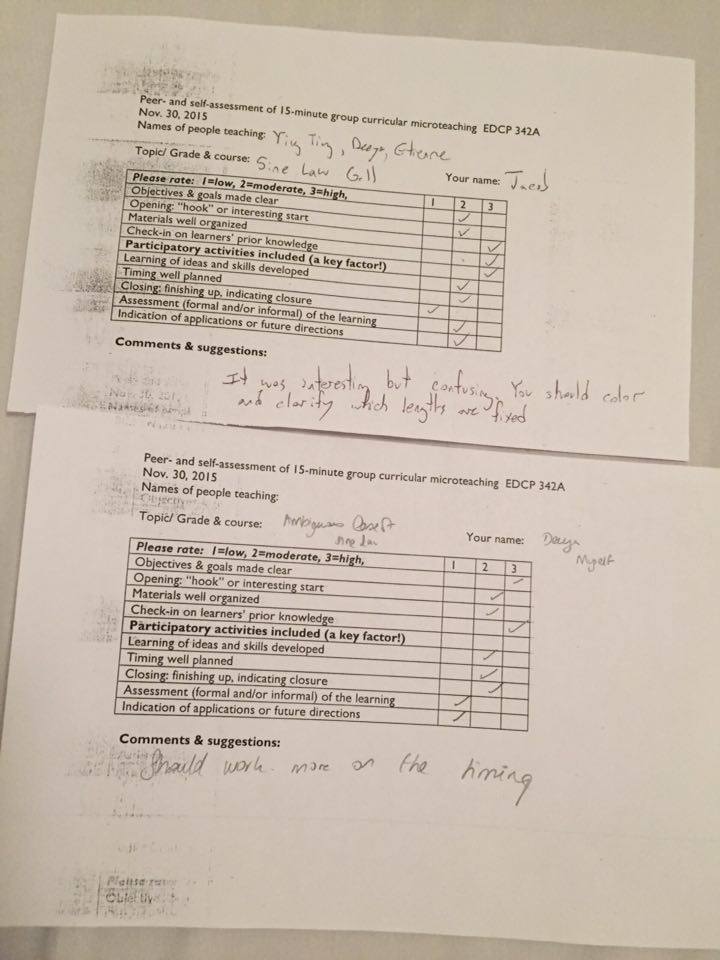
For our second micro-teaching this Monday, Etienne, Deeya and I were presenting our lesson on the Sine Law. I reflect that our teaching topic was interesting, and the materials were a definite bonus to help students visualize. However, the lesson was a bit rushed. I think the reason is that we had three people in the team, with each presents a different sub-topic of the Sine Law, there were a lot of information that we would like to cover for each case. Having 3-4 students per team and let them learn in less than 3 minutes might not have been enough before rotating them and starting on a new sub-lesson. I found that our discussions were cut short due to lack of time, even though there were still a few more ideas to discuss. Furthermore, we should have had a more well-rounded closing/conclusion before ending the lesson.




Sunday, 29 November 2015
Micro-teaching 2: Lesson Plan for Sine Law
|
Title:
Learning the different cases of the
Sine Law
|
|||
|
Date:
November 30, 2015
|
|||
|
Grade
Level:
Pre-calculus 11
|
|||
|
Prescribed
Learning outcomes:
·
Be able to
understand how to apply Sine Law to solve problems.
·
Introduce
oneself of 3 different cases of triangles in applying the Sine Law.
|
|||
|
General
purpose:
The class will look at how the Sine
Law can be used to find the unknown length of the side of a triangle given
one angle and the length of the other two sides.
We will look at three (3) cases:
1.
Where there is
no solution,
2.
Where there is
one solution,
3.
Where there are
two solutions.
|
|||
|
SWBAT
3.5
Sketch a
diagram and solve a problem, using the Sine Law.
3.6
Describe and
explain situation in which a problem may have no solution, one solution, or two
solutions.
|
|||
|
Probing
of Previous Knowledge
·
The class has
already been introduced with the notion of Sine Law (the relationships
between the sides and angles) and the proof of Sine Law.
·
The class understands
basic properties of triangles and knows how to draw a triangle, such as labelling
the angles, sides, and the height, respectively.
·
The class understands
the concept of SOH-CAH-TOA; students are expected to know how to calculate
the height of a triangle using SOH-CAH-TOA.
|
|||
|
Objective
|
Time
|
Activity
|
Materials
|
|
Introduction
|
1 minute
|
·
Ask students
where they see the use of trigonometry in their everyday life.
·
Provide more
background info on trigonometry that appeal to them.
|
|
|
Summary
|
2
minutes
|
·
Ask students if
they can recall what sine law is (just in case not everyone does).
·
Draw a generic,
3-sided triangle.
·
Review the
concept of Sine Law.
·
(With a diagram)
Ask students if they can find an unknown angle or length of a triangle given
the other two lengths and an angle.
Is this always
possible?
|
Whiteboard
Markers
|
|
Inquiry
Project
|
10
minutes
The instructor will spend 3 minutes
with each group, then rotate for a total of 9-10 minutes.
|
·
Introduce to
class the three (3) different cases of the Sine Law.
·
Divide the class
into three groups.
Within each group:
·
The instructor presents
a different case.
·
The instructor
gives each student a set of 3-4 sticks, where students have to make as many
different triangles as they can think of.
·
Once students
are finished making their answers, they have to explain their answers to the group.
·
The instructor
will help to guide the students, writing the problem on the board and
explaining why there is indeed only one, two, or no solution.
|
Measured sticks with which to make
triangles.
Multiple sets for each of the three
cases.
|
|
Handout
+ Summary
|
3 minutes
|
·
Provide the
class with handout on the three cases of Sine Law.
·
Go over the
handout briefly.
·
Use it to show
students that the three different cases necessarily have one, two, or no
solutions.
·
Illustrate this
on the whiteboard.
·
Show the
implications of this when solving the Sine Law.
|
Students may need pen and paper for
this.
|
|
Summary
Evaluation:
By having the students learn from
doing hands-on activities with the sticks (and other visual tools), they can
understand better the numbers of triangles that can be made given certain
angles and lengths.
|
|||
Thursday, 26 November 2015

Sunday, 22 November 2015
What is arbitrary and necessary in teaching (math)?
1. What does Hewitt mean by "arbitrary" and "necessary"? How do you decide, for a particular lesson, what is arbitrary and what is necessary?
According to Dave Hewitt, in a learning setting, "arbitrary" means that students are informed of the learning materials through external sources, such as teachers, books, the internet, and many others; "necessary" means that students do not need to be informed of the learning materials through external sources. Often times, they can work through the questions and figure out themselves. As Hewitt writes in his article, what is "arbitrary" is in the "realm of memory", and what is "necessary" is in the "realm of awareness". I have encountered this kind of thinking and reasoning during my short practicum. There were times when students asked why it must be this way and not that, in which I hear my teacher say, "Sometimes, things are just easier this way." I think many of us new and experienced teachers have asked ourselves this kind of question many times during our teaching, and many of these examples have been cleverly brought up by Hewitt.
For my teaching, personally, I would consider math symbols, notations, or any naming conventions as something that is arbitrary. I am unsure of how I can explain why 2 is bigger than 1, for instance. Number symbols (e.g. 1, 2, 3,...) are universal across the world, so explaining that to students would be difficult for me because we have been taught and memorized this way since the beginning.
I would consider proofs, properties and relationships to be necessary because in many of these cases, they can be derived and worked out by students; students within "awareness" that is. For example, understanding why a parabola is shaped a certain way can be understood by graphing and interpreting the formula because parabolic formulas can be revised. Similarly, one can probably also work out why Speed = distance / time, or why chemical formula is written this way because these formulas can be derived and solved from real-life applications, whereas symbols and notations do not.
2. How might this idea influence how you plan for your lessons, and particularly, how you decide "Who does the math" in your math class?
Hewitt's idea of what is arbitrary and what is necessary really blows my mind on thinking to myself and asking "why". There might even be questions that some university professors and teachers cannot answer because they themselves learned concepts arbitrarily. As a teacher, I will try to dig deeper on the materials being taught in class for the curious minds. I might explain, on the side, why we do math a certain way while showing and explaining that there are alternative methods to do math differently, but it would just be harder for some students to grasp (although they are not limited to solving math their own way as long as they derive a right answer in the end). I know that not all students are capable of understanding the "necessary" component to math, but as long as teachers have an answer to "why", they can use simple hints so students can really ponder on it and "think about it".
Wednesday, 18 November 2015
Exit slip: Reflection on SNAP Math Fair at M.O.A.
Today, our EDCP 342A class had the opportunity as guests to participate the SNAP Math Fair at the Museum of Anthropology. I had a great time meeting talented students from elementary school in Vancouver. What surprised me the most was their ability to reason and think critically on the questions they were presenting. Most of these students were (possibly) in Gr. 6 or maybe even younger, and at that age they could think "beyond the box" with alternate answers and multiple solutions to solve any math problem had even opened my eyes on my own thinking of the questions being presented.
Some of these students were quite eager to present their question. They were able to explain the concepts well that I was able to solve it on my own, and with occasional help from the hints at times. The games were not overly complicated and can be understood easily for their level of learning. As well, I was amazed by how creative and talented these young students were at designing their own math games. Many students had gone out of their way to explore and find common (household) materials and turning them into beautiful and creative art forms!
Some of these students were quite eager to present their question. They were able to explain the concepts well that I was able to solve it on my own, and with occasional help from the hints at times. The games were not overly complicated and can be understood easily for their level of learning. As well, I was amazed by how creative and talented these young students were at designing their own math games. Many students had gone out of their way to explore and find common (household) materials and turning them into beautiful and creative art forms!
Tuesday, 17 November 2015
SNAP Math Fair Response
Ted Lewis, the author of the Math Fair Booklet, poses some very interesting and realistic key points on learning math. Some people fear mathematics because they think that they are incapable of solving problems successfully, so that discourages them to continually pursue math questions. I know a fact that I, for one, feared doing math when I was a younger, especially when I was faced with more abstract math problems. For this reason, problem solving is a great focus to counter the fear of math, especially in Math Fair events because these skill sets can give everyone an opportunity to think and reason beyond the abstract level, into a more concrete and practical area of their lives. Now that the math fair is not been "graded" or awarded, students and visitors will feel less overwhelmed by failures as they are given the chance to perfect their learning continually and gradually.
If I want to incorporate SNAP Math Fair in my practicum high school at Point Grey S.S., I would first start with the younger grades, perhaps the Gr. 8 math classes because students at this age and grade are beginning to step into a more advanced level of math learning, and they are beginning to grasp math even in a more abstract sense. But of course, I should align complexity of math problems that is appropriate for students in Gr. 8 or 9.
If I want to incorporate SNAP Math Fair in my practicum high school at Point Grey S.S., I would first start with the younger grades, perhaps the Gr. 8 math classes because students at this age and grade are beginning to step into a more advanced level of math learning, and they are beginning to grasp math even in a more abstract sense. But of course, I should align complexity of math problems that is appropriate for students in Gr. 8 or 9.
The puzzles or brain-teaser math activities such as the ones proposed in the booklet would be a great starting point for those students to work on, and they should be easy enough for students to teach the visitors, such as families and friends, so they can understand the materials as well. I am also a firm believer that math learning should not be dealt alone. Students can think alone first to process the information and try independently, but ultimately, for more difficult questions they are best solved when students work/collaborate with each other. Perhaps, I can mix the Gr. 8s and 9s math together in groups of 3-4 members. For older grades, I can let Gr. 10s and 11s work together on solving the problems and presenting them to others. Finally, the Gr. 12s will have a chance to solve too, maybe with people within their own grade. Students from the mini schools can work independently within themselves too.
Because this school runs on a tight schedule, with each block of class being only 75 minutes long, time can be a constraint that may not work so well in a SNAP math fair (which can run as long as a day!) Because of the time constraint, I may need to simplify problems and puzzles or reduce the numbers of problems given and making them into groups of 3-5 to solve so problems can be solved quicker as students all pour their skills together. Another way to go about doing this is to combine all the students (from all grades) who have a math block at period 1 day 1, for example, together within this 75 min, then divide them based on their grade levels to avoid unfair math competencies. Once that is done, we move on to the next block. For presentations, students can continue to work and perfect their work on a day 1 again so visitors can come and solve themselves with guidance from the students.
Saturday, 14 November 2015
November 13: End of Week 2 Reflection
I am writing this blog to describe the summary of my 2-week practicum. Overall, I have to say that I am very thankful of the opportunity to teach at Point Grey secondary school under the guidance of my English and math sponsor teachers and my faculty advisor. The students at PG are always full of energy, either it is the first block of the day, after lunch, or the last block of the day where students are dying to go home, they are always enthusiastic and approachable when it comes to learning.
The second week was a lot busier than the first week because I had to teach multiple of classes. I felt I was more nervous to teach the English classes because I have never taught English in a large setting before. In the past, I had mostly worked with individuals to teach grammar and ESL, so the opportunity to teach a class of roughly 30 students was an eye-opening experience.
I realized that in English, there is really no absolute right and wrong answer - as long as there is evidence to support the argument. This style of teaching is unlike teaching and doing math, where there is always one right answer for every problem, even though there may be more than one way of solving the problem. I understand that while teaching, the questions that I bring to the class should be open questions that give everyone a chance to think and discuss. I also realize that I need to be constantly coming up with real-life questions to stimulate students' thinking process on the spot, and those questions should always tie with the topic of my lesson. In other words, to be able to improvise is important to all teaching professions.
Ultimately, as a teacher, I am here to let students learn, think, and reason. I should be giving students the chance to think for themselves, under the proper guidance and tools. Just as a Bachelor of Education student myself, my faculty advisor, my sponsor teachers, and my Education professors are all here to make me (and the rest of us) a better teacher, for now and the future.
Ultimately, as a teacher, I am here to let students learn, think, and reason. I should be giving students the chance to think for themselves, under the proper guidance and tools. Just as a Bachelor of Education student myself, my faculty advisor, my sponsor teachers, and my Education professors are all here to make me (and the rest of us) a better teacher, for now and the future.
Monday, 9 November 2015
November 9 Reflection
Today, I was supervising and helping English classes in the morning and math classes in the afternoon. From my supervision and assisting the teachers and students, I realize that speaking with a higher volume is very important as a teacher - especially if we are standing in front of 30 something students! We need to make sure that students in the back can hear us clearly so they don't fall behind. Speaking loudly also shows a certain level of assertiveness and confidence in the subject we are teaching.
As well, having a clear instruction for all students is equally important. This ensures that students are all on the same page and clearly know what to do. They would know what is expected of them and what they should accomplish in class.
Friday, 6 November 2015
November 6: End of Week 1 Reflection
In the past couple of days during the week of my practicum, I have been busy preparing lesson plans, meeting the students and teachers, going to various non-math and English classes to learn about different teaching/class management styles.
I have attended a Chemistry 12 class, a Japanese 11 class, and a ELL class. I find that the language-based classes are generally are more interactive and involved than the math and science classes. The math and science classes are more subject-based (subjects and contents are more important), and in language/art classes are more analytical (analysis and thinking are more important).
I have two classes that are repeated for this short practicum, both math and English. I realize that even though they are the same classes, the students' response, thinking and behaviours in that same grade and subject area are all different. In addition, I realize that teachers have slightly different teaching strategies and methods for every class they teach (regardless if they are repeated or not).
For this one week being at a school, I learned about...
For this one week being at a school, I learned about...
- Students are all different at their own levels - their competencies, abilities, personalities, etc.
- Teachers are all different in terms of their teaching and practices.
- The amount of discipline that's needed to control the classrooms are almost consistent from the youngest grade (9) to the oldest grade (12). E.g. some Gr. 9s need more discipline than the Gr. 12s, and some Gr. 12s need more discipline than the Gr. 9s.
- Students at Point Grey are very passionate about what they learn and what their hobbies are. From the clubs that I have attended and observed, students are not only passionate about the big things (e.g. humanitarian clubs) but also about the littlest things that I often don't think about, which amazes me!
- Students do notice me and acknowledge my presence even if they didn't say Hi to me in the classes I observed. (They always come up to me and tell me that I was in his/her's this class and that class, and I didn't even know!)
Tuesday, 3 November 2015
November 3 Reflection
Today is a very interesting day. My FA, Susan, drop by Point Grey s.s. to resolve some administration situations. I have a new math SA now, which I am very happy about.
I met up with my SA and the two of us talked for awhile about my lesson planning and what content materials her students are learning for each class. I realized that even though she is teaching multiple of the same classes every week, the class atmosphere, environment, structure and the students are very different. For instance, the morning Gr. 11 morning class is very different from her Gr. 11 afternoon class.
Today, I also had the chance to interview the librarians at the school. I never knew they had so much responsibilities to do at the back-end. While I was interviewing them, I never realized how difficult it is to recieve tech support (i.e. fixing computers, software programs, etc.) at this school. They openly admitted to me that tech support is very low, and they needed more staff who can help them resolve any computer/programming issues. The staffs aren't trained on how to resolve tech issues because most of the problems are fixed by and at the central school board. So most of the time when something is down, they have to wait until the school board tech staff fix the issues remotely on their end - so it's really a waiting game.
Monday, 2 November 2015
November 2: First day of short practicum!
Today is my first day of our short practicum at Point Grey Secondary School. I met a few other UBC and SFU teacher candidates who will also be working with sponsor teachers in various subject areas. I am the only math TC at this school.
The morning began with a detailed orientation and breakdown of work procedures in the classrooms. We toured around the school and met different teachers and staff members along the way. Point Grey is a very big school! It is quite old as it was built in the 1920s, but the school has maintained itself very well since then. The staff was very friendly and knows what's going on at school. Our secretary is our go-to person if we ever needed help on admin.
Some other interesting things that I have learned today:
- The school alone has over 60 student clubs! I noticed that there isn't a math club... maybe I can start one!
- I'm really interested in their Comp Sci Club and the Dance Team. I want to check them out! They sound really fun.
- A slight change of plan on who my sponsor teachers are going to be. Hopefully we can resolve this by the end of this week.
- The students in the math and English classes that I have attended are very energetic and friendly. I dropped by a pre-calculus 11 class with fewer than 15 students. It was a quiet class and majority of the class time was devoted to homework time and extra practice. I was able to help out the students whenever I could.
- Students in the AP math class are very ahead and the teaching pace is very fast. Teachers allocated 5-10 min work time before taking up the questions.
- For those who are in enriched or AP classes (especially in Gr.11 or 12), I'm curious as to what they want to pursue in post-grad - maybe I can help them if they want to study math!
Tuesday, 27 October 2015
Battleground Schools
From reading this article, the main argument that it is addressing is dichotomies surrounding mathematics education in North America. It is certainly interesting (and a bit scary!) to know that there are math teachers out there, either elementary or secondary, who are successful in mathematics learning and teaching, and yet the reason they are so successful in math purely because they have been "memorizing" algorithms and concepts in their brains without much sense on "why" they worked or why they are as they are. Interestingly, if a math teacher carries this sense of learning in his or her classrooms, there would be a chance that their students would also carry this mindset of math learning. This can be shown in their ability to educate themselves on how to interpret math. Most of the math education reforms, the Progressivist movement, the New Math Reform, and the "Math Wars" of NCTM, gave me new insights into their different ways of teaching and learning in that specific period of time. But I think that math learning over time is starting to focus more on the importance of real-life applications and what students can do with math in the future instead of just simply memorizing everything that deemed important.
From looking at the table between Conservative and Progressive stances in mathematics education, I think that I fit under the Conservative view more than Progressive view, depending on the level of schooling I had done in the past as a student. When I was younger, I attended part of elementary schooling in China and part in Canada. My perspective of math learning in China was highly conservative. Teachers would be drilling concepts and math formulas into my brain without necessarily telling me why that is. Interesting fact about me is that I used to really dislike math when I was younger because I was just not getting the concepts! However, as I came to Canada, this level of learning and assessment changed slightly. Math is no longer just about working by yourself, timing your arithmetic abilities in under 60-seconds and getting all the right answers. Some of my Canadian math teachers do focus more on the "why" and the "how" instead of focusing a lot on getting the answer. There were more collaborations and group work involved, which is what I want accomplish as a math teacher in the future as we live in the time of change and advancements.
Thursday, 22 October 2015
Reflection on Micro-teaching (evaluation)
I enjoyed our first micro-teaching topic on something that is non-academic! The topics from our presenters were quite diverse and very interesting, though I wished I could have stayed longer to listen to all of the presentations.
My micro-teaching topic was on tea, more specifically on the history of tea and how tea has influenced and shaped the meaning of our cultures through time. From my reflection of my own presentation and how others evaluated my presentation, I had a clear objective in mind, the materials were well organized, and the scope of tea and its impact on societies from different parts of the world were thoroughly covered in the 10-minute presentation. One thing that I need to work on would be to include more participation from students. I need to include more ways to assess their learning and understanding by asking questions that are more challenging to get their minds moving. I should have brought in more fun activities for them to work on, but I guess there were so much materials that I wanted to cover but couldn't in a short period of time. Another thing I need to work on is to control the volume of my voice. I need to speak louder so that everyone can hear me clearly (especially when there are other groups presenting at the same time).
Overall, I had an enjoyable time learning new materials from other teacher candidates! Thank you all for sharing your knowledge with me!
Tuesday, 20 October 2015
Micro-teaching: Lesson Plan
Presenter: Ying Ting Lu
Topic: Tea
Topic: Tea
| Task | Checklist |
|---|---|
Objective of the Lesson
|
- Teach the historical and cultural influences of tea. - Make aware of the structure and different types of tea available (including its health benefits). - Indicate the cultural and social influence of tea in other countries. |
Opening
|
-Opening up by asking if anyone drink tea, and what kinds of tea they like to drink. |
Materials
|
- Laptop to present the slides. Each slide: aim for 2-3 minutes.
- Various tea samples. |
Check for prior knowledge
|
- Check to see if students know the essentials of tea and tea-making. |
Activities
|
- Ask them which tea they drank before, and which they enjoyed the most (hot and cold). - Let them look at the sample teas. - Time: < 1 min. |
Ideas/skills developed
|
- Attain strong knowledge on the history of tea, and its impact on human society. |
Timing
|
Entire presentation: aim for 8-10 minutes! |
Closing
|
- Conclude the usefulness and influence of tea all over the world. - Relate the facts to students. |
Check for Understanding
|
Ask: which three countries have the biggest influence on tea. Who “invented” the first tea and where? What are the four common types of tea? (orally) |
Assessment
|
- Allow more time for students to participate in the presentation. - Encourage students to ask questions for clarification any any point of teaching. |
Indication of Future Application/direction
|
- What other tea traditions do they know? - How can tea influence anything beyond culture and society? - Can tea improve the overall well-being of humans? |
Saturday, 17 October 2015
Estimating the Dimensions of Campbell's Soup Water Tank
For this week's math problem, we are asked to find the estimated dimensions (length, width, volume) of a Campbell's soup water tank! This is a very interesting problem. I had fun doing this activity, except there were a lot of researching and estimating involved!

To get started with the problem, I needed to create a visual tool to help me estimate the water tank, and in the picture, the bike definitely helped with the problem! Looking at the picture as above, I began using the measurement of the bike to help me find the dimensions of the water tank. Several factors were involved in this process...
Susan's bike looks like a hybrid bike for commuting (road + mountain). I researched the standard (recommended) hybrid bike size for women who are 165 cm, which is Susan's height. The biker's inside leg length, according Cycle Experience, is 76 cm (http://www.cycleexperience.com/getting_the_right_size.php). This length is important because I figured that the length of the inseam is 76 cm for her height, and usually when bikers stand while sitting on the bike seat, their feet should still touch the ground without the need to tiptoe. Now, looking at the handle bar, according to MEC, the height for a road/mountain bike, is adjusted at 2.5 cm to 5 cm. Judging by the picture of her bike, it looks like it's raised 5 cm above the seat. So, the total length, labeled in green, of the bike should be, roughly, 81 cm. As well, since the tank is slanted, I have to take the top bit of length into account. I estimated it to be roughly 20 cm. Finally, the total length, or the diameter, of the tank is 81 cm + 81 cm + 20 cm = 182cm.
(http://www.mec.ca/AST/ContentPrimary/Learn/Cycling/Bikes/AdjustingYourSeatAndHandlebars.jsp).
From there, we can calculate the radius of water tank is 182/2 = 91 cm (roughly).
Now, as for the length, labeled in yellow, I researched the estimated length of a standard road/mountain bike, and it is 1.8 m (http://safety.fhwa.dot.gov/ped_bike/tools_solve/fhwasa12018/). For the remaining blue label, I used the measurement of the diameter of the bike tire. According to Harris Cyclery (http://www.sheldonbrown.com/rim-sizing.html), the diameter is measured to be 21 cm roughly. In total, the height of the water tank is 180 cm + 180 cm + 21 cm = 381 cm.
From these estimated calculations, the volume of the water tank is...
Pi * r^2 * h = Pi * 91^2 * 381 = 9,911,916.459 cm^3.
This is equivalent to roughly 2618.451 gallon!
I think this is definitely a fun activity for students to work on and get their brains thinking! I can sense that as students are working around this problem, they are probably very curious as to who ultimately gets the right answer! Working at this problem has allowed me to explore the realm of bicycles as well. Who knew there are so many types of bicycles out there. And in all cases, math is so important because we need measurements of our body to pick the best bike to ride. As for the volume of the water tank, we needed to estimate the dimensions, such as the diameter and the height of this cylinder water tank, based on the bike shown in the picture.
Friday, 9 October 2015
The Imaginary Letters
After teaching for 10 years, I had received two letters from my past students with both positive and negative comments about my teaching. The positive letter from my student was very encouraging and motivating. However, the negative letter raised a lot of concerns on my part. The student didn't really enjoyed my class as much as others because it was too easy and not challenging enough. I wished I knew before so that I can make the course more challenging for students to stretch their brains than just simply giving them the information that's required to be learned for the curriculum. I should have created more complicated math problems that they could solve, such as a fun math brain teaser or an interesting math riddle that get students thinking.
The student also commented on my lessons telling me that the materials I provided was too superficial (or not enough information provided). I should provided them with more background information or the history of the contents covered in class than just telling them what it is we are learning for the today, how to get the correct answers, or what teachers are looking for. I feel that just by simply telling them these concepts without challenging them might be too superficial.
One more comment made was that I gave too much homework. I guess not all students like to do homework after class. Maybe I could give them a bit of homework time in class (say, for the last 15-20 min of class) so students could feel more motivated to do work since they were already learning the topic anyway. It would also be a good opportunity for them to talk it out, walk around the class and seek help from myself and others. Perhaps some students just felt less motivated to take out their textbook and get started right away - they might have been distracted doing practices at home or not have enough resources. I thank my students for their emails and letters! It's still a good time to modify my teaching strategies and some of the other things I hope for as a teacher. Thank you!
One more comment made was that I gave too much homework. I guess not all students like to do homework after class. Maybe I could give them a bit of homework time in class (say, for the last 15-20 min of class) so students could feel more motivated to do work since they were already learning the topic anyway. It would also be a good opportunity for them to talk it out, walk around the class and seek help from myself and others. Perhaps some students just felt less motivated to take out their textbook and get started right away - they might have been distracted doing practices at home or not have enough resources. I thank my students for their emails and letters! It's still a good time to modify my teaching strategies and some of the other things I hope for as a teacher. Thank you!
Math/art Project Reflection
For our first assignment, I actually
had fun doing this project with my team! At first, it was a little
difficult to have everyone agree on one specific idea on what shape
to make because there are so many shapes that we can build with just
binder clips! Our ideas are constantly changing as we weigh in on the
pros and cons. We started building the stars with binder clips, since
star shape alone has quite a few math structures that we can talk
about with our class. However, we thought wouldn't it be more fun to
expand on that idea by connecting the individual shapes together and
to create a sphere?
I think this project would be great for secondary school students, particularly those in Gr 9 or Gr.10. It really helps them to be creative and build whatever shapes they want so the end result would be a 3-D sphere. Our team took many trials before deciding on the shapes that would be strong and durable to hold the structure together, so I can imagine the Gr.9 and Gr.10 students getting their hands dirty and exercise their brains on creating a strong and durable sphere made out of binder clips! It's all trial and errors. If a shape is too weak and unstable (not solid enough), they will have to take the shapes down and rebuild it.
I think this project would be great for secondary school students, particularly those in Gr 9 or Gr.10. It really helps them to be creative and build whatever shapes they want so the end result would be a 3-D sphere. Our team took many trials before deciding on the shapes that would be strong and durable to hold the structure together, so I can imagine the Gr.9 and Gr.10 students getting their hands dirty and exercise their brains on creating a strong and durable sphere made out of binder clips! It's all trial and errors. If a shape is too weak and unstable (not solid enough), they will have to take the shapes down and rebuild it.
As you can see, creating the desired structures with just binder clips need a lot of patience, effort and teamwork, which helps students with their communication skills. Communication, which I see in my team, was crucial because there were incidents when we weren't informed on what shapes to build and how to build it. Problem-solving is another area that can help students develop through this project. Students may ask “How can we build this shape so that a specific pattern follows to ensure durability?”, or “What are the ways (patterns) to link all the shapes together so that the sphere won't fall apart?” For math problems, students may wonder “How many different patterns do we see in a particular shape as this?”, or “How many clips do we need to invest so that all vertices are connected equally without having an extra vertex hanging unused (and all shapes are used accordingly)?” These are just some of the many questions that students may think with others.
In all, this project definitely helps Gr.9 and Gr.10 students to develop their sense of spatial visualization and spatial reasoning, as defined by the BCMT in high school level. Making connections and finding patterns to shapes is very important in this project because they need to know what 3-D shape to build upon, so the rest of the steps would be easy. It is also useful for students at Gr.9 and 10 levels because it can help them with their visualization between and among 3-D objects and 2-D shapes. If they find it difficult to visualize in 3-D, they can always draw 2-D shapes to get them started thinking (as many of our team members have done also). Doing so can help them visualize and interpret new ideas and helping each other. As well, because not all students can draw 3-D shapes on paper, so by using and manipulating concrete materials as binder clips, we hope that they can think abstractly and deeply about the process of building; possibly to reason with each other if certain steps make more sense than the other, if not try with different methods.
Subscribe to:
Posts (Atom)